HOST INTRO
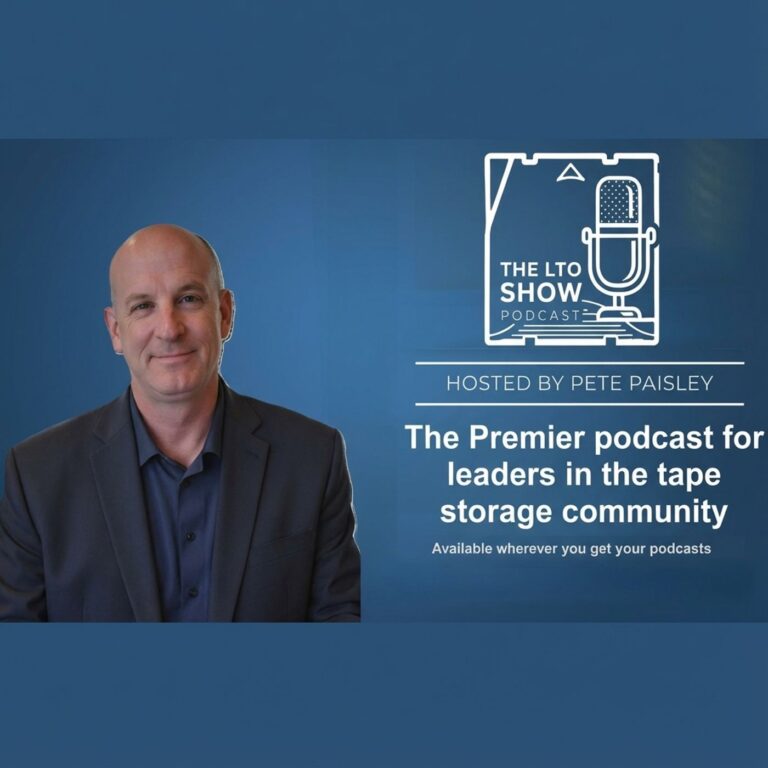
The LTO Show, the premier podcast for leaders in the LTO tape storage community. Each episode dives deep into the business and technology issues that matter most, featuring pioneers, innovators, and thought leaders who are driving advancements in tape technology, data archiving, and long-term storage solutions. The LTO Show keeps you informed and inspired.
Welcome to the LTL show, the premier podcast for leaders in the tape and storage industries. I’m your host, Pete Paisley. In each episode, I bring you conversations with industry leaders who are contributing in special ways to the tape storage community. Our goal is to deliver fresh insights into the business case for LTO tape, helping you understand why tape remains one of the most cost effective, reliable, and sustainable solutions for long-term data retention.
Today, I’m pleased to welcome Rich Gadomski, Director of Channel Sales and New Business Development at Fujifilm Data Storage Solutions. Rich is a true industry veteran with decades of experience in evangelizing for tape. And he brings a unique perspective from one of the world’s leading tape media manufacturers.
We had a wide ranging conversation that covers so much ground. We dive into the state of the LTO industry as a whole, where we’ve been and where we’re headed. We explore the new LTO 10 update and some of the technical details behind the new media with its impressive 40 terabyte native capacity and what that means for organizations managing explosive data growth.
I was also able to probe a bit with Rich on how the LTO consortium operates, the collaboration between those founding members, IBM, HPE, and Quantum, and how tape media producers like Fujifilm work within that ecosystem as they manage the LTO roadmap and keep tape competitive.
And finally, we discussed the important advocacy work happening at the Active Archive Alliance, where Rich serves as a board member. The Alliance is doing critical work, educating the market about tape’s role in modern data strategies and championing the entire tape ecosystem.
This was a conversation packed with insights on LTO tape storage you won’t want to miss.
So let’s get started.
INTERVIEW WITH RICH GADOMSKI
PETE:
I’m glad to be joined by Rich Gadomski, Director of Channel Sales and New Business Development at Fujifilm Data Storage Solutions. Rich, thanks for joining us today.
RICH:
Hey, thanks very much, Pete. This is a pleasure to be here.
PETE:
Yeah, good to see you again. So Rich, I wanted to dive into the new LTO 10. What are you guys calling it at Fujifilm? Some are saying high capacity LTO, LTO 10 enhanced, enterprise LTO 10. How are you talking about it?
RICH:
Yeah, well, I think we’re going to follow the lead of the technology provider companies press release, LTO.org. They came up with something really creative, LTO 10, 40 terabyte. So actually pretty simple and it makes sense.
PETE:
Okay. And maybe some of the OEMs can put some other terminology around it then. So, just as a reminder for our viewers today, LTO 10 40 terabyte is the new enhanced extended higher capacity version of LTO 10, which first shipped as 30 terabytes. And it’s based on a new tape formulation. So Rich, what are the details around this?
RICH:
Base layer, first of all, that I’m hearing about the Aramid base layer. I hear it’s a descendant of Kevlar bulletproof vests.
So apparently it is used, the Aramid fibers are used in Kevlar vests. I think Aramid is known for its strength and high heat tolerance. So, you know, it’s ideal for this application, but it’s definitely a stronger base film. So therefore it can be thinner than the standard polyester type base film that we’ve been using for other products. And therefore you can get more linear feet of tape in the cartridge. And Aramid also has better environmental properties so we can expand the operating environment in terms of heat and humidity.
PETE:
So what are the details behind what I read as the strontium doped barium ferrite recording layer?
RICH:
Right. So barium ferrite has been the de facto magnetic particle that we’ve used up through LTO9. And for LTO10, we started to add strontium ferrite, which is the next gen magnetic particle, even finer, smaller in aerial density, if you will, than the barium ferrite. And therefore it allows for higher aerial density, higher capacity. But it’s mostly barium ferrite. Strontium ferrite is the minority component of the magnetic layer. But we had already introduced a mix of strontium ferrite and barium ferrite in the TS1170 cartridge, which enabled the 50 terabytes of that product.
PETE:
Were there changes for the 40 terabyte version?
RICH:
I don’t think dramatically. Because of the Aramid base film, they were able to add linear footage to the cartridge based on the thinner base film. I’m not a hundred percent sure that there was any change in the magnetic layer.
PETE:
What about improved temperature and humidity tolerances?
RICH:
Totally agree with what IBM has said. The big hyperscalers, if they can run their data centers warmer, more humid, it means less air conditioning expense. Those data centers are huge. So if the tape can improve that, and it does push the corners in terms of humidity and temperature, that’s very important for them and this product.
PETE:
Who is the target market for the 40 terabyte LTO 10?
RICH:
The early adopters for these new type products tend to be the hyperscalers and the very, very large HPCs. If the hyperscalers can get their hand on that extra density and capacity, it makes all the difference in the world for them.
PETE:
The new roadmap cut future capacity expectations. Thoughts?
RICH:
These roadmaps have always been targets. They’re influenced by what the market really needs and what can be brought to market cost effectively. There’s always trade-offs between capacity, performance, and price. It’s not necessarily a technology limitation. It can very much simply be more of a business and market oriented decision.
PETE:
How does Fujifilm work with IBM and the consortium?
RICH:
We work very closely in the new generation development, providing a lot of media samples back and forth, testing on the drives. We work very closely with IBM as a development partner in producing the media and finding the right mix and optimum capacity.
PETE:
Concerns about consolidation in the ecosystem?
RICH:
As long as demand is solid and growing, and I believe it is, I’m not too worried about the ecosystem. Artificial intelligence, IoT, digital transformation — nobody wants to delete data anymore because it can have future value. Energy consumption and total cost of ownership also favor tape. I’m very bullish about the future because demand is strong.
PETE:
Tell us about the Active Archive Alliance.
RICH:
Active Archive Alliance is technology agnostic. It’s about getting the right data in the right place at the right time at the right cost, always keeping it accessible and online. Tape plays a role, but so do disk, flash, cloud, and new technologies. It’s about intelligently managing data growth cost effectively for the long-term.
PETE:
What keeps you excited about tape?
RICH:
I’ve been in tape storage since 1991. Tape technology has never sat still. We’re always pushing the technology envelope. The tremendous opportunities in archival storage for AI applications are exciting. AI data goes cold, but it can’t be deleted. It will be reused and reanalyzed. Tape continues to climb the roadmap. The format that never dies.
HOST OUTRO
Thanks to our audience for joining us on the LTO Show. I want to thank Rich Gadomski for joining us today and for his willingness to address some tough questions about our LTO industry.
I particularly appreciated Rich’s insights into the LTO roadmap and the reminder that IBM and Fujifilm demonstrated a 580 terabyte LTO drive several years ago. That gives real confidence in the technical roadmap through LTO 13 and beyond.
He also explained the many business factors that impact each generation. It’s not just about what’s technically possible, but what makes sense for the market.
Rich gave valuable perspectives on the ecosystem, potential new manufacturers, and the advocacy work of the Active Archive Alliance, especially as we face exponential data growth and increasing pressure to manage storage costs sustainably.
If you found value in today’s episode, please share it with colleagues in the storage business and join us next time on the LTO Show as we continue exploring the business case for LTO tape storage.
I’m Pete Paisley. Thanks for joining us.