The data storage industry has long struggled with the environmental sensitivity of tape systems. Temperature and humidity directly affect tape performance and error rates, forcing organizations to build and maintain dedicated climate controlled tape rooms. IBM’s newly announced Climate Controlled Diamondback tape library changes that equation entirely.
This is the first tape library engineered from the ground up to operate reliably in the same elevated temperature and humidity conditions as modern data center infrastructure. Scheduled for availability in 2026, the Climate Controlled Diamondback represents a major shift in how tape storage integrates into hyperscale, high density, and energy optimized environments.
For organizations using adiabatic cooling, operating at higher ambient temperatures, or consolidating infrastructure footprints, this innovation removes a long standing barrier to tape adoption.
The Environmental Challenge in Tape Storage
Tape drives are precision devices. Inside each drive, Tunneling Magneto Resistive heads read and write data at extremely high densities. LTO 10 is estimated to use roughly 15,000 tracks on a half inch tape. At this density, even microscopic contaminants can cause problems.
A single dust particle, fiber, or airborne contaminant can lodge between the tape and the head, causing read or write errors, performance degradation, and potentially permanent damage. Over time, contamination accelerates wear, increases error rates, and shortens the lifespan of drives that can cost tens of thousands of dollars each.
Temperature and humidity introduce equally serious risks. LTO tape media and drive mechanisms are designed to operate within defined limits, traditionally topping out at 32 degrees Celsius and 80 percent relative humidity. Exceeding these thresholds can slow backup operations, increase errors, or cause failures altogether.
High temperatures affect dimensional stability in drive components, while excessive humidity can cause tape media to expand or contract. In extreme cases, condensation may form on internal components, creating catastrophic failure scenarios.
Historically, organizations faced a tradeoff. They could take advantage of tape’s dramatic energy efficiency and cost benefits, but only by maintaining separate, tightly controlled tape rooms. For modern data centers intentionally running hotter to reduce cooling costs, this requirement often made tape impractical.
IBM’s Neutral Pressure Innovation
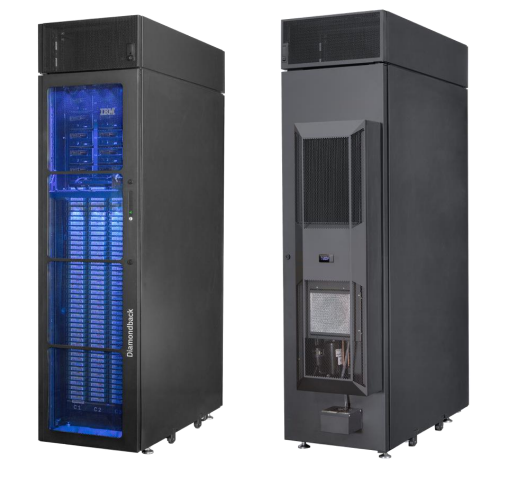
The Climate Controlled Diamondback solves these challenges with an integrated environmental control system that maintains optimal internal conditions regardless of external data center temperatures up to 45 degrees Celsius and humidity levels as high as 90 percent with a 24 degree Celsius dew point.
This operating envelope extends into ASHRAE A4 territory, far beyond what traditional tape libraries can support.
At the heart of the design is a sealed and insulated enclosure with double paned glass doors and gasketed panels. An integrated variable speed air conditioning unit actively cools the internal environment, but IBM’s approach differs fundamentally from other contamination control strategies.
Rather than relying on positive or negative pressure, the system maintains neutral air pressure inside the library. Internal air is continuously recirculated and cooled, minimizing air exchange with the surrounding data center.
This design contrasts with positive pressure systems that rely on filtered external air to push contaminants outward. While effective in theory, those systems depend heavily on filter maintenance and careful pressure management. Filter failure or pressure imbalance can compromise protection and increase operational complexity.
Many traditional tape libraries provide no meaningful contamination protection at all. Drives are often exposed at the rear of the library, with fans pulling unfiltered air across sensitive components.
IBM’s neutral pressure approach avoids these pitfalls. Cold air from the integrated cooling unit mixes with recirculated internal air before being drawn into the tape drives. Condensation management is built into the system to handle temperature differentials safely.
According to IBM specifications, this approach reduces contamination risk by up to 90 percent compared to standard Diamondback libraries. It achieves this without filters that require regular replacement and without stressing seals or panels through pressure differentials.
Real World Impact and Economics
The operational benefits extend well beyond environmental specifications. Organizations using co location facilities can deploy tape without requesting dedicated climate controlled rooms, potentially reducing tape related deployment costs by up to 30 percent.
For hyperscale operators running data centers at elevated temperatures to reduce cooling expenses, the Climate Controlled Diamondback enables tape usage in environments that were previously incompatible.
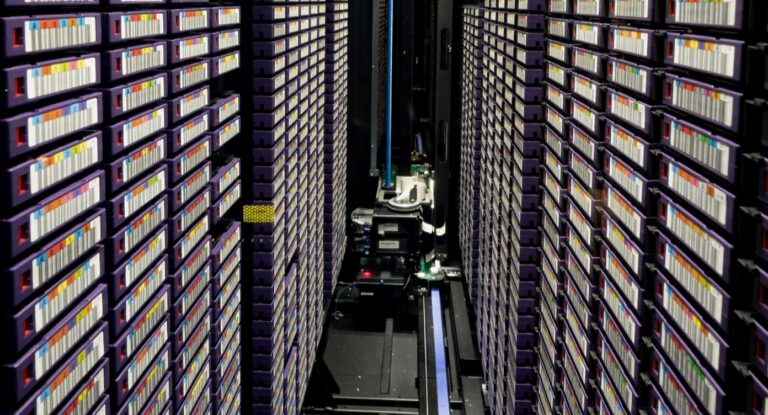
The system preserves tape’s core economic advantages. Power consumption remains under 10 percent of comparable hard disk systems, with a maximum draw of approximately 1.8 kilowatt hours. A single frame configuration supports up to 14 LTO 10 drives and 1,548 cartridges, delivering nearly 62 petabytes of uncompressed capacity.
When paired with IBM Deep Archive solutions, the library supports ASHRAE A3 environments, covering the majority of modern data center deployments.
Serviceability is also carefully considered. A visual indicator shows when internal temperatures have equalized with the external environment, allowing safe door opening without condensation risk. If immediate service is required, technicians can pause the cooling system and wait for temperature stabilization, protecting both media and drive components.
Industry Implications
The Climate Controlled Diamondback signals a broader shift in how tape is positioned within modern infrastructure. Rather than requiring special accommodations, tape is now engineered to coexist seamlessly with energy efficient data center designs.
This development removes a major adoption barrier for organizations evaluating long term archive strategies. The decision is no longer about whether a data center can support tape, but whether tape’s cost, energy, and durability advantages align with organizational needs.
In an era of exponential data growth, rising energy costs, and increasing sustainability pressure, that question is likely to be answered in tape’s favor more often than ever before.
For additional details, see the IBM data sheet at
https://load.se/wp-content/uploads/2025/11/data-sheet_climate-controlled-diamondback.pdf
Pete Paisley is the host of The LTO Show, the premier podcast for leaders in the LTO tape storage hardware community. Please reach out with story ideas or comments. We respond to each directly at pete@ltoshow.com.
Copyright 2026 The LTO Show and Pete Paisley
Linear Tape Open LTO, the LTO logo, Ultrium, and the Ultrium logo are registered trademarks of Hewlett Packard Enterprise, IBM, and Quantum in the United States and other countries. All product and company names are trademarks or registered trademarks of their respective holders. Use of them does not imply any affiliation with or endorsement by them.