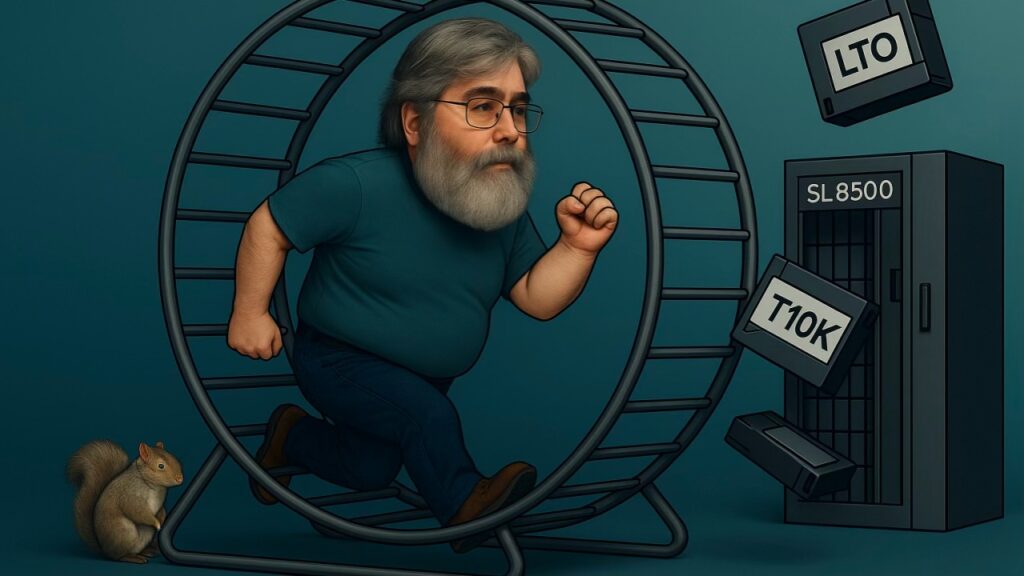
When the Versity audit output landed on my desktop last quarter I nearly spilled my coffee. Here was an LTO-9 tape with roughly 63 million files and about 36 terabytes of data (assuming a 2:1 compression ratio), representing nearly 15 percent of the curatorial collection for that group’s archival space. A second tape clocked in at over 40 million files, and the rest of the collection sprawled across another 20+ cartridges summing to roughly 150 terabytes and over 415 million individual objects. The good news? The tapes are readable. The bad news? At the current throughput and file size distribution, recalling all the data would take months — over half a year — due to files being small in size and sequential media physics eating throughput for lunch.
That moment crystallized a question I’ve been kicking around for years: Can a single preservation object — like a tape cartridge approaching or exceeding 100 terabytes — become too much liability for the preservation process and operational environment? And just as importantly: What happens across the next five generations of Linear Tape-Open (LTO) tape if we don’t rethink how we protect these gargantuan archives?
In this article I unpack the liabilities hiding in plain sight, the future roadmaps, and the strategies — including erasure coding on and across tape, redundancy schemes beyond “just more cartridges,” and architecture changes the industry badly needs.
Setting the Stage: The Era of Massive Tape Objects
Let’s be clear: Tape isn’t dead. Despite sensationalist takes (including some social media memes), LTO technology continues to grow in adoption and capability — 176.5 exabytes shipped in 2024 was reported, marking multi-year growth despite claims of obsolescence. LTO-9 cartridges already offer about 18 TB native (~36 TB compressed) and the upcoming LTO-10 promises ~30 to ~40 TB native [depending on media selected] (~100 TB compressed at 40 TB) per cartridge. The roadmap stretches through Generation-14 with theoretical single-cartridge capacities approaching the petabyte zone within the next decade.
This isn’t speculative hype. The LTO Program’s roadmap — the collaborative, open format spearheaded by Hewlett Packard Enterprise, IBM, and Quantum — shows capacity scaling and reliability enhancements designed to keep tape relevant alongside disk and cloud for long-term retention.
But with this exponential storage density comes a hidden risk: media bloat.
When a single “media” becomes tens to hundreds of terabytes — physically contiguous and logically monolithic — the operational work of preservation gets ordered differently. It’s no longer “write some data, store it safely.” It becomes: recoverability planning with 6-month recall windows, media handling and head-wear risk profiles that weren’t designed for multi-petabyte workloads, maintenance of integrity across millions to billions of discrete files stored as one tape object.
In short: at scale, a bad tape isn’t just bad — it’s a multi-hundred-thousand-dollar operational headache waiting to happen.
Why Size Matters: Liability Vectors for Large Tape Objects
Tape historically succeeded because of its cost per byte, offline “air-gap” security posture, and longevity — archival life spans of 15–30+ years when stored properly under controlled temperature and humidity conditions. But every upside has a flip side:
Sequential Object Penalty
Tape’s sequential nature — fantastic for streaming writes — is brutal when per-file access latency trumps throughput. Tens of millions of tiny files stitched into one massive tape means seek overhead and throughput cliffs due to physical head movement and tape motion physics. There’s no random access magic here — just wait for it… wait for it… boom — when you finally hit the files you need. That’s months of recall time, as in the real-world example above.
Mechanical Wear and Environmental Stress
The more data you write and read from a single cartridge, the more physical cycles you consume. Airborne contaminants (dust, oils, particulates) degrade the critical head-to-media interface and accelerate read/write errors if storage environments aren’t meticulously controlled. Even rewind/seek cycles contribute to media stress, shortening the practical lifespan of cartridges and drives.
Reliability Beyond Manufacturer Specs
Error correction and bit error resilience in tape systems are strong (indeed, some patented approaches use Dual Reed-Solomon erasure coding to bring bit error rates below those of hard disk drives), but these are device-level protections. They’re designed for random errors and transient media aberrations, not the catastrophes presented by media loss or unreadable segments on a single multi-terabyte object.
Operational and Management Complexity
Managing a tape library with hundreds of small cartridges is operationally simpler than managing dozens of monsters where each one is a critical single point of failure within your archive. Traditional preservation practices — multiple copies, geographical distribution, integrity checks — get stretched thin when each object holds orders of magnitude more data.
The Traditional Approach to Tape Redundancy (And Its Limits)
Historically, tape environments relied on:
- multiple copies of key archives across tapes,
- offsite rotations for disaster recovery,
- periodic integrity checks and migrations to fresh media.
This strategy works well when each tape represents a manageable slice of the archive. When each tape is the archive — that model strains.
Next-gen approaches must move beyond mere replication.
Erasure Coding: Tape’s Next Frontier
At its core, erasure coding breaks data into chunks with redundancy woven in such that missing chunks (from failure or unreadable media) can be reconstructed from the remaining pieces. For distributed disk object storage, this is well understood; for tape, adoption has been slow until recently.
Erasure Coding Applied to Tape Cartridges
Patents and experimental implementations exist for embedding erasure codes directly into tape cartridges using two-dimensional codes like Dual Reed-Solomon, meaning a tape could survive lost sections and still reconstruct data. It’s the kind of sophistication we take for granted in object stores, but baked into magnetic tape itself.
Library-wide Redundancy: RAID for Tape
Systems like “Redundant Array of Independent Tapes” (RAIT) are conceptually akin to RAID in disk arrays — spreading data and parity across multiple tapes so that the loss of one doesn’t doom an archive. Vendors such as Quantum have implemented related two-dimensional erasure code schemes (e.g., RAIL, Redundant Array of Independent Libraries) that can recover objects using local reconstruction codes across tapes. This extends tape beyond “one cartridge = one archive” into aggregate logical durability.
Erasure Coding Across Objects
Software layers above the tape — archival and preservation platforms — can distribute chunks of objects (or parity) across multiple media, enabling reconstructability in the face of a single cartridge failure, or even multiple failures if redundancy settings support it.
Designing Environments That Survive Tape Failure
Multi-Tape Erasure Planning
Don’t treat tapes as monolithic end points. Spread objects across parcels with parity that allows reconstruction if one or two cartridges fail. Set redundancy to match business risk tolerance.
Define F failures tolerated (e.g., 2 lost tapes)
Encode across N tapes with F parity sets
Model recovery time against restoration SLAs.
Proactive Integrity Scanning and Repair
Akin to scrubbing in disk systems, schedule systematic verification of every tape’s error rates, and correct detected corruption before it becomes catastrophic. Track metrics across library lifespans and build automation to refresh or re-encode when thresholds are hit.
Environmental Controls and Handling SOPs
Tape’s Achilles’ heel remains physical. Proper storage temperatures, humidity control, and handling procedures aren’t just good practice — they’re prerequisites for 15-30+ year media viability.
Library Architecture for Performance
Mixed workloads benefit when you decouple archive ingest patterns from retrieval patterns. If you expect frequent small file restores, consider tiered approaches where tape serves as the durable store while index and metadata live in faster disk/object tiers. Then, recall performance is less dependent on tape sequential penalties.
Tape Market and Preservation Software Landscape
Tape Ecosystem
LTO remains the de facto open format for enterprise tape, with multiple generations in flight and broad vendor support — courtesy of the LTO Program partnership among HPE, IBM, and Quantum. Other innovations, like holographic ribbon systems (e.g., HoloMem’s research into ~200 TB cartridges that fit into existing form factors), show the market is thinking beyond magnetic tape but co-deployable in existing libraries.
Software for Management and Preservation
Tactical tape usage is still largely governed by legacy backup software and hierarchical storage management (HSM) engines. However, modern digital preservation platforms — especially those oriented toward object stores with erasure coding, fixity checks, and format migration workflows — bring new resilience paradigms to cold data. Integrating tape into these systems demands software that understands:
- distributed redundancy,
- cross-media integrity verification,
- multi-generation format evolution,
- metadata continuity across migrations.
What Needs to Change
Tape can’t mature in isolation. Key evolution areas include:
- Native erasure encoding in tape formats — making parity part of cartridge architecture.
- Cross-media preservation metadata standards so tape and disk/object stores share fixity and lineage info.
- Better integration between library automation and preservation workflows so integrity isn’t an afterthought.
Patent activity shows interest in deeper error tolerance strategies historically in disk arrays, and we’re starting to see similar thinking applied in the tape ecosystem via two-dimensional codes and RAIT strategies. The next step is wider adoption and openness.
My Take: Why We Should Embrace the Complexity
Here’s the unpopular view among some purists: A large archive isn’t just a big pile of bits — it’s a living, evolving system. And systems, by definition, have failure modes that we must engineer against.
Yes, tape can hold a petabyte in a single cartridge someday. But does that help if your CIO is on the hook for six-month recall windows because a single piece of media gargantuan in size and microscopic in physical fragility becomes a bottleneck?
We need to stop thinking of tape as “write it and forget it.” Instead, think of tape as one substrate in a broader, redundant preservation architecture.
- Erasure coding on tape protects against media segment losses.
- Redundancy across tapes protects against cartridge failure.
- Software-defined preservation layers protect against format and media obsolescence.
Relying solely on traditional parallel copies — while not wrong — is increasingly insufficient at the scales we’re now engineering for.
The Road Ahead: Five Generations and Counting
The LTO roadmap — now extending through Generation-14 — envisions cartridges that might approach or exceed a petabyte of compressed storage by around 2034. That’s not hype; it’s capacity planning.
Whether you love tape or loathe it, tape’s continuing evolution is clear:
- Native tape capacity rising geometrically,
- Growing industry adoption even in an era of cloud and object stores,
- Innovations in encoding, library architectures, and hybrid storage strategies.
The liability question is less about whether tape can hold that much and more about whether our architectures can manage, protect, and — when necessary — recover that much without catastrophic operational cost.
This isn’t niche academic fear-mongering. It’s pragmatism rooted in decades of seeing archive projects go sideways because someone treated a massive tape stack as a static endpoint instead of a critical part of the data lifecycle.
Conclusion: Liability or Asset? The Choice Is Architectural
So can a preservation object — like a tape with 100 TB+ — become too much liability for your process and environment?
Absolutely, if you treat it like traditional tape: a static container, with minimal redundancy, no cross-media parity, and no proactive recovery planning.
Not at all, if you design your archive around resilience:
- native and cross-tape erasure coding,
- distributed redundancy strategies,
- environmental management,
- integrated preservation software that treats tape as part of a system, not just media.
Tape isn’t dying — it’s transforming. But unless we transform our thinking about how to protect very large logical objects, that transformation may come with operational risk that CIOs, CTOs, and senior IT leaders will rue down the road.
Research
- Tape adoption growth and capacity shipments: Unstructured data growth and record tape capacity shipments (176.5 EB in 2024) reported by the LTO Program Technology Provider Companies (HPE, IBM, Quantum). Unstructured Data Growth Drives Record Tape Shipments in 2024
- LTO-9 and roadmap details: LTO Program Ultrium roadmap with generation info including LTO-9 specs and backward compatibility details. LTO Ultrium Roadmap & LTO‑9 Details
- LTO-10 30 and 40 TB capacity announcement: LTO-10 technology details showing capacities up to ~40 TB native and 100 TB compressed. LTO‑10 Tape Generation Details
- LTO Program overview and roadmap importance: LTO Program press release archive with shipment and technology news. LTO Program Press Releases
- LTO Ultrium background: Wikipedia overview of Linear Tape-Open (LTO) technology and format history. Linear Tape‑Open (LTO) Technology Overview – Wikipedia
- LTO durability and handling requirements: LTO tape archival durability, storage conditions, and environmental needs from Wikipedia. LTO Durability & Handling Requirements – Wikipedia
- Longevity and benefits of tape archive: Tape durability and archival longevity explanation (15–30+ years) from a storage durability deep-dive article. Understanding Tape Data Durability & Longevity
- Environmental contaminants and tape reliability: Dust and particulate contamination effects on magnetic tape and handling recommendations. Dust & Environmental Effects on Tape – IASA Preservation Guide
- Quantum Scalar tape libraries and RAIL/erasure coding: Quantum Scalar tape storage overview, including RAIL tape architecture reference. Quantum Scalar Tape Libraries & RAIL Architecture
- Two-dimensional erasure coding discussion context: Two-dimensional erasure coding across tapes and libraries (2D EC) used in scalable tape/object systems. 2D Erasure Coding Across Tape & Libraries (Quantum ActiveScale Tech Brief)
- Emerging holographic storage relevant to tape ecosystem: HoloMem’s holographic ribbon storage aiming to rival magnetic tape with ~200 TB cartridges. Holographic Ribbon Storage Aims to Surpass Magnetic Tape
Carl Watts is a Technical Advisor to The LTO Show, the premier podcast for leaders in the LTO tape storage hardware community. Please reach out with story ideas or comments, we’ll respond to each directly. pete@ltoshow.com
Copyright 2026 The LTO Show and Carl Watts
Linear Tape-Open LTO, the LTO logo, Ultrium and the Ultrium logo are registered trademarks of Hewlett Packard Enterprise, IBM and Quantum in the US and other countries. All product and company names are trademarks™ or registered® trademarks of their respective holders. Use of them does not imply any affiliation with or endorsement by them.