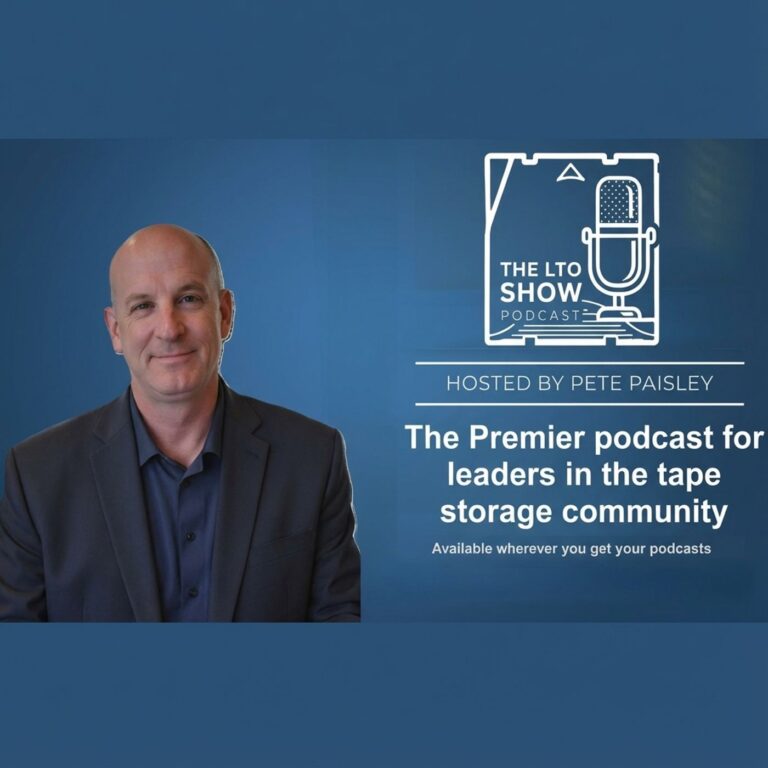
Host Intro
PETE PAISLEY:
Welcome to The LTO Show — the premier podcast for leaders in the tape and storage industries. I’m your host, Pete Paisley. Each episode, I bring you conversations with industry leaders who are contributing in special ways to the tape storage community. Our goal is to deliver fresh insights into the business case for LTO tape storage — and today, we’re exploring one of tape’s most critical applications: preserving the media and entertainment industry’s explosive content growth.
I’m thrilled to welcome Tom Coughlin, CEO of Coughlin Associates, a leading analyst firm that has been tracking storage technology trends for years. Tom recently completed a comprehensive survey of the media and entertainment sector, and the results reveal fascinating insights into how production facilities — from corporate video producers to Hollywood studios — are managing their storage challenges.
Here’s what we’re covering today: Tom will walk us through the current landscape of storage technologies — hard drives pushing toward 100 terabytes with HAMR technology, LTO-10 tape now at 40 terabytes native capacity with a roadmap to potentially 1-petabyte cartridges in the 2030s, and emerging optical technologies that could reshape archiving.
We’ll dive into Tom’s survey results showing that LTO represents 85% of the magnetic tape used for long-term archival in media and entertainment. We’ll also break down the economics: storing a petabyte for 20 years costs about $780,000 with hard drives versus just $234,000 with LTO tape — a savings of over half a million dollars.
We’ll explore the pain points these facilities face:
- 36% have over 2,000 hours of content in archives
- 57% are growing at more than 6% annually
- Many are working with content ranging from standard definition up to 16K resolution
The data volumes are staggering, and the need for cost-effective long-term preservation has never been greater.
Tom brings decades of storage industry expertise and hard data to back up what many of us already know: LTO tape isn’t legacy technology — it’s the smart economic choice for long-term archiving at scale.
Segment 1 – Introduction and Overview
PETE PAISLEY:
We’re very pleased to have Tom Coughlin from Coughlin Associates on The LTO Show to discuss his most recent survey on data storage in the media and entertainment sector. The results include valuable insights on tape storage. Tom, welcome to the show.
TOM COUGHLIN:
Thanks, Pete. Great to be here. Always happy to talk about storage technology.
PETE:
Tom, you’ve been studying the media and entertainment storage landscape for many years. Could you share a bit about your background and what led you to focus on storage in the media and entertainment industry?
M&E Industry Storage Overview
TOM:
The media and entertainment industry is experiencing tremendous growth in content creation. We’re seeing higher resolutions, higher dynamic range, and more content being produced than ever before. The question becomes: where does all this data go? How do organizations archive it cost-effectively while ensuring long-term preservation?
We surveyed industry participants to understand their storage strategies, and the results paint a very interesting picture of where the industry is headed.
PETE:
Before we dive into the survey results, let’s talk about the storage technologies themselves. You looked at hard disk drives, magnetic tape — particularly LTO — and emerging optical technologies. What does the current landscape look like?
TOM:
Let’s start with hard disk drives. These electromechanical devices have been around since IBM introduced the RAMAC system in 1956. Today’s hard drives are available up to about 36 terabytes. By next year, we expect 40-plus terabyte drives, and before the end of this decade, we could see 50 to 60 terabytes — possibly even higher.
PETE:
LTO tape capacities per cartridge often match the current maximum HDD capacity. What’s driving HDD capacity increases?
TOM:
The key technology is HAMR — Heat-Assisted Magnetic Recording. Seagate introduced this in volume after several years of qualification. HAMR will significantly increase areal density growth. We’re projecting at least 100-terabyte hard drives early next decade, possibly 150 terabytes or more.
We’re also seeing shingled magnetic recording and higher disk counts — up to 12 disks per drive — further increasing capacity.
LTO in Media & Entertainment
PETE:
Now let’s talk about the star of our show — LTO tape. What’s the current state of LTO?
TOM:
LTO dominates the tape market. The latest generation, LTO-10, offers 30 to 40 terabytes native capacity — or 75 to 100 terabytes with 2.5x compression.
Historically, LTO generations doubled in capacity every two and a half to three years. While recent generations haven’t quite doubled, the roadmap remains impressive.
By the end of the 2030s, we could see 365 terabytes native and over 900 terabytes compressed — possibly even a 1-petabyte cartridge.
PETE:
That would be a remarkable milestone. How does LTO compare economically?
TOM:
LTO tapes are significantly less expensive than hard disk drives on a dollar-per-terabyte basis, especially when considering lifecycle costs like energy consumption.
In our 20-year cost analysis for storing one petabyte — assuming media replacement every five years — hard drives totaled about $780,000, while LTO tape was approximately $234,000. That’s roughly 30% of the HDD cost.
PETE:
So potentially over $500,000 in savings.
TOM:
Exactly. And that analysis didn’t fully account for energy savings, which would further favor tape.
Survey Participants and Pain Points
Tom explains that surveyed facilities ranged from mid-sized companies (101–500 employees) to large enterprises. They produce a wide range of content, including:
- TV episodes
- Feature films
- Corporate and government video
- Social media content
- Commercials and trailers
- Broadcast television
- Webcasts and games
A major driver across all segments is increasing resolution — from SD to 8K and even 16K — dramatically increasing storage requirements.
Survey Results
Key findings include:
- External HDDs: 30%
- Local storage networks: 19%
- Digital tape: 15%
- Cloud: 11%
- LTO represents 85% of magnetic tape usage
36% of respondents have over 2,000 hours of archived content.
57% report archive growth above 6% annually.
14% are adding 1,000+ hours per year.
25% still have over 2,000 hours of unconverted analog content.
Concerningly, 31% never copy or replace archives — increasing long-term data loss risk. Best practice suggests migration every 10 years or less.
Emerging Technologies
Tom discusses optical innovations such as:
- Sony & Panasonic Optical Archive
- Folio Photonics multi-layer discs
- Optera optical hole burning
- Microsoft Project Silica
- SPhotonix quartz storage
- Cerabyte ceramic storage
While promising, tape remains the most mature and cost-effective archival solution today.
Conclusion
PETE:
The future looks bright for storage — and LTO remains well positioned for long-term archiving.
TOM:
Absolutely. Flash dominates capture. HDDs serve nearline storage. LTO remains the most cost-effective long-term archival solution at scale.
Host Outro
I hope you enjoyed our conversation with Tom Coughlin. His research is invaluable for those of us in data protection, particularly in media and entertainment.
One key takeaway: storing one petabyte for 20 years costs about $780,000 with hard disk drives versus just $234,000 with LTO tape.
Another critical point: 31% of respondents never replace their archives. That’s a recipe for data loss. Migration — ideally every 10 years or less — is essential.
Content creation is accelerating. Resolutions are climbing. AI will only increase storage demand further. Organizations that build smart archiving strategies now — leveraging LTO’s cost advantages and reliability — will preserve their valuable content for decades.
Thank you to Tom Coughlin from Coughlin Associates for joining us.
See you next time on The LTO Show.
Subscribe wherever you get your podcasts, and join us as we continue exploring the business case for LTO tape storage.